
Description
Edmund Wilson (1895–1972) stands as one of the most influential American critics of the twentieth century. His work shaped the careers of F. Scott Fitzgerald, Ernest Hemingway, and many other writers of the Modernist period. Wilson’s private notebooks and diaries offer a direct view into the literary world he inhabited, and they remain essential primary-source material for scholars.
A Rare Early-State Production Document
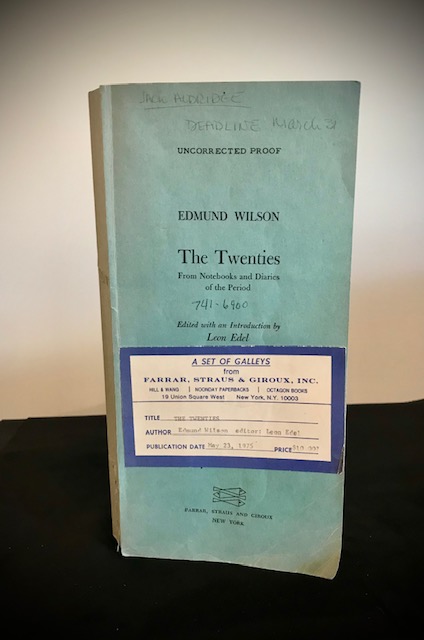
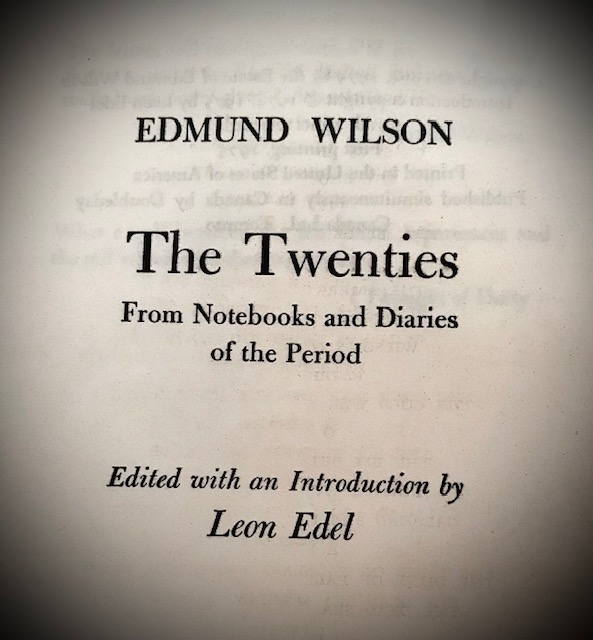
This Edmund Wilson publisher’s galley is an early, pre-publication proof of The Twenties: From Notebooks and Diaries of the Period. Farrar, Straus & Giroux produced it in late 1974 or early 1975 for final editorial review. These galleys were printed in extremely small numbers and were not intended for public distribution. Their purpose was simple and practical: to capture final corrections before the book moved into typesetting.
The galley retains its original wrapper and displays the characteristic tall, narrow format used by FSG during this period. It contains uncorrected text and early-state pagination, which allows scholars to observe how the work evolved prior to publication.
Routing Marks and Editorial Circulation
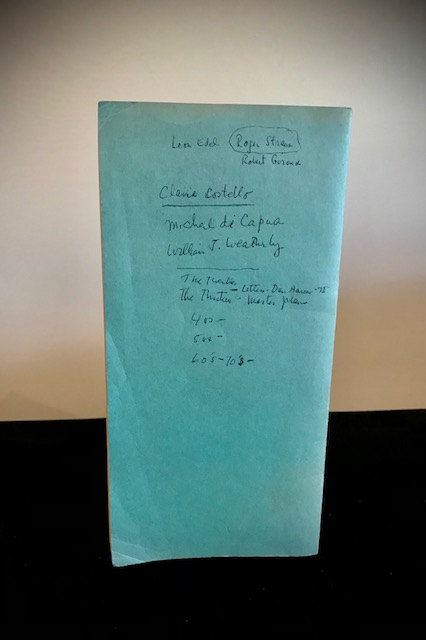
Handwritten notes on the back cover document the galley’s movement through FSG’s senior editorial offices. The routing list includes:
-
Roger W. Straus Jr., co-founder and publisher
-
Robert Giroux, one of the leading editors of his generation
-
Leon Edel, editor of this volume and renowned Henry James biographer
-
Claire Costello
-
Michael di Capua
-
William T. Weatherby
Straus’s name is circled, suggesting that this copy was directed to him or handled under his review. This detail provides strong internal provenance. It also places the galley within the decision-making structure of one of America’s most respected literary publishers.
Unique Editorial Features
This galley includes handwritten corrections and marginal notes in multiple editorial hands. Each change illustrates the collaborative process that shaped the final text. Early-state editorial markings offer insight into FSG’s production practices and reveal how Wilson’s posthumous materials were prepared for print.
Significance for Research and Collectors
This artifact will interest collectors and scholars working in:
-
twentieth-century American literature
-
Modernist studies
-
the history of editing and publishing
-
Edmund Wilson’s critical legacy
-
archives of Farrar, Straus & Giroux
-
manuscript studies and pre-publication states
Because galleys were fragile and produced in extremely small quantities, very few survive. Even fewer retain routing information linked to Straus, Giroux, and Edel. Therefore, this example represents a rare opportunity to study the inner workings of FSG during a pivotal moment in American publishing history.
Its preservation allows readers and researchers to examine the formation of a significant posthumous text and to trace its movement through one of the most discerning editorial institutions of the twentieth century.







Reviews
There are no reviews yet.